
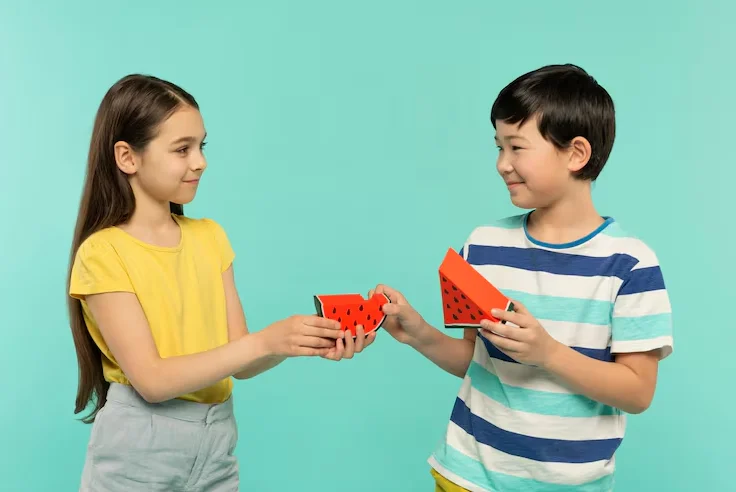
Sharing is a skill that requires patience, empathy, and self-control—qualities that four-year-olds are just beginning to develop. At this stage, children are naturally protective of their belongings, as they are still learning about ownership and social interaction. Teaching your child to share is less about forcing the act and more about guiding them to understand the joy and benefits of generosity.
Before diving into strategies, it’s important to understand your child’s developmental stage:
Strong sense of ownership – At this age, children are still figuring out the concept of “mine” versus “yours.”
Developing empathy – They are starting to recognise others’ feelings, but it’s not fully formed.
Short attention span – They may want to play with the same toy repeatedly, making it harder to give it up.
Recognising these factors helps you approach teaching with patience instead of frustration.
Children learn best by observing adults. Make a point to share your own belongings, snacks, or time with others. For example:
Offer your partner a bite of your meal and say, “I’m sharing because I care about you.”
Share materials during a family activity, such as colouring or baking.
When children see sharing as a normal part of interaction, they are more likely to imitate it.
For young children, turn-taking is often easier to understand than the abstract idea of sharing. Use a timer or a song to mark when it’s time to swap.
Example: “You can play with the truck for two minutes, and then it’s your friend’s turn.”
Praise the action when your child successfully gives up the toy: “You waited patiently, and now it’s your turn again!”
When your child shares—whether willingly or after encouragement—acknowledge it immediately.
Say: “That was kind of you to let your sister play with your toy.”
Use specific praise rather than generic phrases. This helps them understand exactly what behaviour you appreciate.
Arrange playdates, group activities, or cooperative games that naturally involve sharing. Board games, building blocks, or art supplies work well because they encourage collaboration.
Children connect strongly with stories. Books such as “Llama Llama Time to Share” or “The Rainbow Fish” illustrate the concept in ways they can relate to emotionally. After reading, discuss the story and ask:
“How did the character feel when they shared?”
“How do you think their friend felt?”
If your child refuses to share, avoid grabbing the toy from them. Instead, acknowledge their feelings:
“I know you’re enjoying playing with that car. When you’re done, your friend can have a turn.”
This approach teaches empathy and patience without making them feel powerless.
It’s reasonable for a child to have certain “special toys” they are not required to share, like a favourite teddy bear. Let them put these away before friends visit, so they feel secure.
Use pretend play to show how sharing makes others happy. You might role-play with stuffed animals: one has many toys, the other has none. Act out what happens when one shares, and talk about the feelings involved.
Learning to share is a gradual process. Some days will go smoothly; other days, your child may resist. The key is consistency—reinforce the behaviour each time, and over time, it will become second nature.
Teaching your four-year-old to share is about more than just polite manners—it’s about helping them build empathy, kindness, and social skills that will benefit them for life. With patience, positive reinforcement, and plenty of real-life examples, your child will gradually learn that sharing not only feels good but also strengthens friendships.
Latest Article
What Couples Can (and Can’t) Expect of Their Wedding Party
How Long Does It Take to Plan a Wedding?
Can You Drive in Europe with a US License?
Property Taxes in India: Complete Guide for Americans
How to Get a Mortgage for Overseas Property as an American
Share This Article